
In many states, aggregators operate without a licence; in others, with the risk of the licence being revoked by any regional transport office on the slightest pretext.

BJP heavyweights Smriti Irani, Arjun Munda, Ajay Mishra Teni and Kailash Chaudhary were among the 13 Union ministers who tasted defeat in the 2024 Lok Sabha elections, as stunning losses in three Hindi heartland states forced the BJP to rely on allies to form the government.

At least 16 people lost their lives in various rain-related incidents in Telangana while the unprecedented rainfall and floods in Andhra Pradesh over the past three days affected about 4.5 lakh people leading to the evacuation of more than 30,000 to relief camps.

As many as 44 flights to and from the Kempegowda International Airport in Bengaluru were cancelled owing to the Karnataka bandh over the Cauvery water sharing issue with Tamil Nadu, airport authorities said.

Promoting ethanol-friendly cars, turning river Ganga into a waterway and rolling out 50 stalled road projects are three top agendas for him.

Shivakumar has got the all-important Major and Medium Irrigation and Bengaluru City Development, including the Bruhat Bengaluru Mahanagara Palike (BBMP), Bangalore Development Authority, Bangalore Water Supply and Sewerage Board, Bangalore Metropolitan Region Development Authority and the Bangalore Metro Rail Corporation Limited.

A sum of Rs 7060 crore is provided in the current fiscal for the project of developing one hundred Smart Cities.

India also went on an overdrive in expanding its military engagement with like-minded countries in its neighbourhood and beyond in the face of China's relentless attempts to become a regional hegemon and establish its primacy in South Asia.

Saha has kept the home, health and family welfare and public works department with him while Ratan Lal Nath has been given the charge of power, agriculture and farmers' welfare, according to an official notification issued by Chief Secretary J K Sinha.

With this allocation of portfolios, the Sharad Pawar-led NCP has got most of the 'plum' ministries.

The second wave of the pandemic in the country has derailed the recovery momentum of the domestic auto industry, which was poised for a comeback in the current fiscal after witnessing the two consecutive challenging years, ratings agency ICRA said on Thursday. Unlike the first wave where infections were largely localised to urban clusters, the second wave has seen deeper and wider penetration, including into rural hinterlands. Accordingly, outlook for various segments has been revised downwards, it said.

'This is what happens to a party when it gets trapped in the vicious circle of nepotism and dynastic politics'

Mumbai Monorail was to be built in two phases - Phase I of 8.93 km and Phase II of 11.20 km. The first phase ran operations for around three years before services were abruptly halted, owing to a fire incident last year. The second phase now stands completed, but is lying closed.

At a time when consumers increasingly embrace green mobility solutions, it is not electric cars but hybrids that are taking the lead, as automotive sales data indicate. Since January, 64,097 electric cars have been sold compared to 266,465 hybrids, according to data from the ministry of road transport and highways' Vahan dashboard. Hybrid car sales have surged from 4.42 per cent of the 4.1 million cars sold in calendar year 2022 to 7.2 per cent this year.
At a time when consumers increasingly embrace green mobility solutions, it is not electric cars but hybrids that are taking the lead, as automotive sales data indicate. Since January, 64,097 electric cars have been sold compared to 266,465 hybrids, according to data from the Ministry of Road Transport and Highways' Vahan dashboard. Hybrid car sales have surged from 4.42 per cent of the 4.1 million cars sold in calendar year 2022 to 7.2 per cent this year.

NavIC consists of a constellation of seven satellites and a network of ground stations and is touted to be more accurate than GPS.

These include home, industrial development (mining), justice, labour, excise, environment conservation and climate change, disaster management and rehabilitation and civil aviation.

Higher disposable incomes, rural push and infra push to boost auto sector

Stocks of public sector undertakings (PSUs) have been on fire in the past year as investors cheered an improvement in key operating metrics and embraced counters of these state-owned enterprises, analysts suggest. The S&P BSE PSU Index has gained over 90 per cent in the past year, rising much higher than the S&P BSE Sensex, which has rose nearly 19 per cent during this period, according to ACE Equity data. The BSE PSU Index, reports show, has delivered a compound annual growth rate (CAGR) of 28 per cent (including dividends reinvestments) over five years and risen by almost 60 per cent in the past year.

Of these 8.5 million additional people employed in September, 6.5 million were in rural India, reveals Mahesh Vyas.
The automobile sector is considered a good indicator of economic health. It has a very long value chain, from primary materials, like metals, glass and plastic, to value-added high-end electronic components, specialised alloys, and software.

The first dimension of this vision will be to build physical as well as social infrastructure for a $10-trillion economy and to provide ease of living: Goyal.
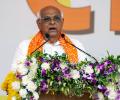
Patel was administered the oath as the 18th chief minister by Governor Acharya Devvrat at a function held at the Helipad Ground near the new Secretariat.

'People will say a lot of things -- ignore the noise.'

The gig economy can serve up to 90 million jobs in the non-farm sectors in India with a potential to add 1.25 per cent to the GDP over the "long term", a report said on Tuesday. The gig economy, where workers get hired typically for short durations, can lead to transactions of over $250 billion over the long term, the report by the consultancy firm BCG said. The firm said gig economy is not a new concept but has seen greater adoption following the advent of technology.

Weak consumer sentiment across urban and rural markets due to slow farm inflows, subdued agri-commodity prices, rising cost of ownership as a result of regulatory changes including safety, emissions, vehicle registration, along with a rise in interest cost/EMI, have impacted demand.

'EV-charging is the next big opportunity after fuelling'

'Loss of these urban salaried jobs is, therefore, likely to have a particularly debilitating impact on the economy, besides causing immediate hardship to middle-class households,' points out Mahesh Vyas.

With a revival in demand and consumption, FMCG companies are looking forward to 2022 with positivity and hopes of sustaining a healthy growth trend across both rural and urban markets while gearing up to cater to the ever-increasing digitally active consumers and tackle the challenge of higher commodity prices. Health and wellness and convenience are going to remain key trends and FMCG companies are strengthening their core brands, driving premiumisation across their portfolios with targeted innovations as consumers are gravitating towards trusted brands looking for quality, purity and hygiene, in continuation of the trend that started since the pandemic last year. FMCG makers are accelerating digitalisation and are investing in building capability in e-commerce and Direct-to-Consumer channels, identifying it as a key vector of their growth as the threat of a possible third wave is still not away.

It is for the first time in the history of Independent India that not a single Muslim is part of the Union Cabinet.

These stocks offer the best combination of maximum 'buy' recommendations from brokerages and share price upside over the next 12 months.

Making the announcement, Chief Minister Uddhav Thackeray said the measure was being taken in urban areas across the state from Monday to ensure social distancing.

'We are planning load shedding in such a way that the entire state will not suffer.'

Five days after the induction of 18 ministers into his cabinet, Maharashtra Chief Minister Eknath Shinde on Sunday allocated portfolios, keeping Urban Development and 11 other ministries with himself, while giving the crucial Home Department to Deputy CM Devendra Fadnavis.

Portfolios were on Tuesday allocated in the new Bihar cabinet headed by Chief Minister Nitish Kumar who, predictably, retained the all-important home department which helps him keep direct control on the state police.

Tata Motors on Monday launched the country's first CNG truck in the medium and heavy commercial (M&HCV) vehicle segment in the 28- and 19-tonne nodes. Most truck makers, including Tata Motors, currently offer CNG only in the small and light commercial vehicle segments. The company also launched a fleet of seven trucks in the intermediary and light commercial vehicle (I&LCV) segment, meant for varied applications.
Domestic passenger vehicle retail sales declined eight per cent in February as the companies continued to suffer production loss due to chip shortage, automobile dealers' body FADA said on Friday. The passenger vehicle (PV) sales dropped to 2,38,096 units last month, down 7.84 per cent from 2,58,337 units in February 2021. "Even though the passenger vehicle (PV) segment saw some launches and slight respite in supply due to better production, it was not enough to meet customer demand. "Vehicle waiting period thus remains similar to what it was in the past few months," FADA president Vinkesh Gulati stated.

Minister of state for personnel Jitendra Singh said it is a major step to place the right talent for the right role.
As the second wave of the Covid-19 pandemic abates, India's automakers are hopeful of a quick recovery in sales volumes, led by better rural sentiment, low interest rates, improved availability of finance and a gradual uptick in business and economic activity. In fact, companies have started to ramp up production already, encouraged by high order books and the growing preference for private transport in both rural and urban areas as a means to avoid infections. In early April, the industry had been bullish as the sales trend for March showed that the effects of the Covid-19 pandemic had been left behind. The total vehicle sales had grown by 77 per cent, albeit on a lower base, and for the past few months, sales had consistently touched 300,000 units per month.

The Delhi Metro Rail Corporation (DMRC) authorities on Sunday reiterated that stations located in containment zones, as per the status on the day of journey, will remain closed.
